Your collection, finally catalogued. By a team that never forgets a reference number.
A collection keeper, a hunt tracker, a price researcher and a dealer book, built around what you collect. One living registry of what you own and what you're chasing. Ready in about two minutes.
You know every piece by heart, and nobody else does. The spreadsheet is three years stale, the receipts are in four inboxes, the waitlists live in your head, and the price you said you'd pay for the grail is a feeling. A collection this good deserves a registrar, a scout, a researcher and a secretary. Now it can have them.
A collection in action
Screenshots of the real product over a demo watch collection. The same registry, stage path, charts and gallery work for whatever you collect.
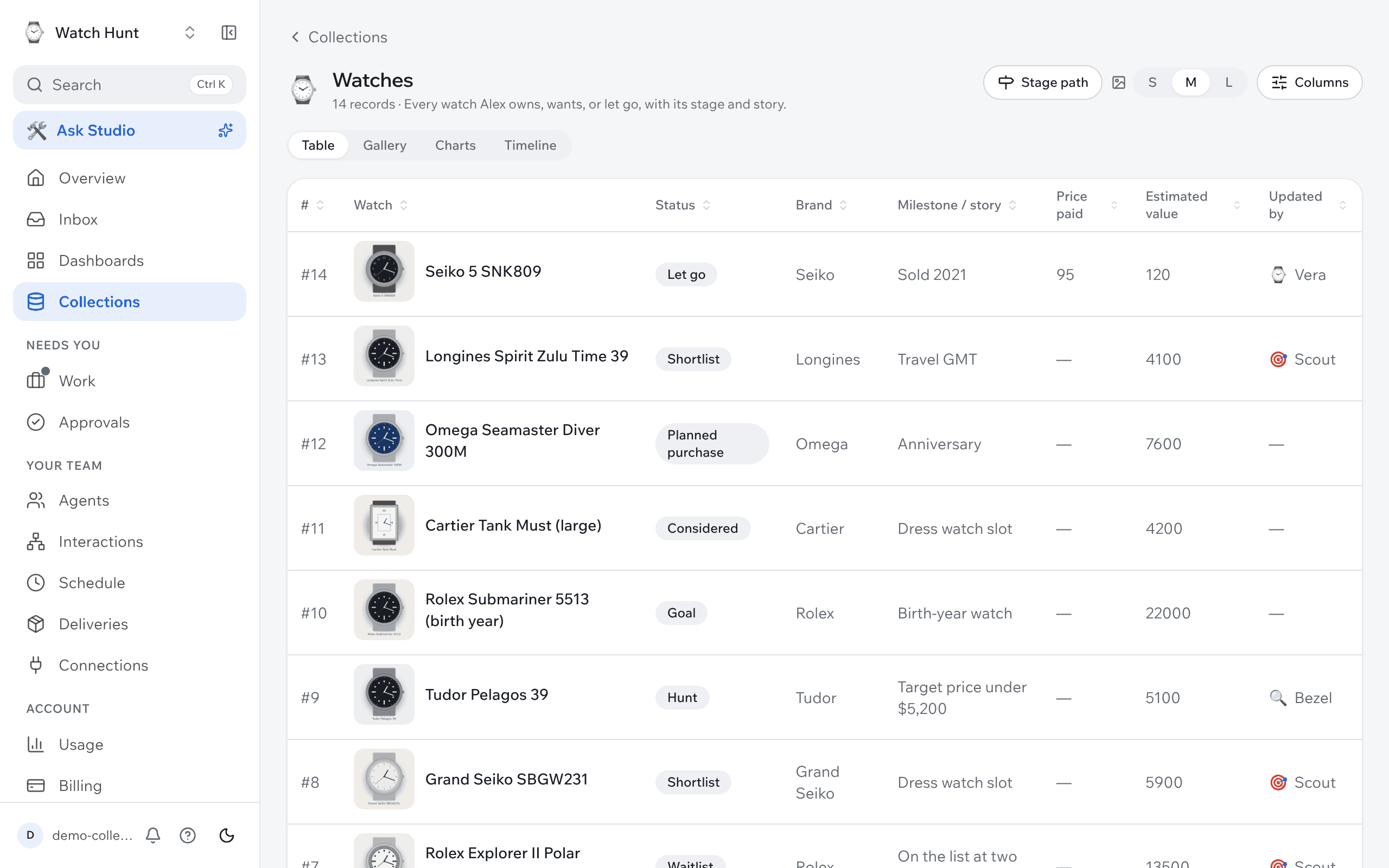
The registry, as a table
One row per piece with its photo, status, brand, milestone, price paid and recorded value. The last column shows which agent last touched the row, when one did: Vera the keeper, Scout the hunt tracker, Bezel the price researcher.
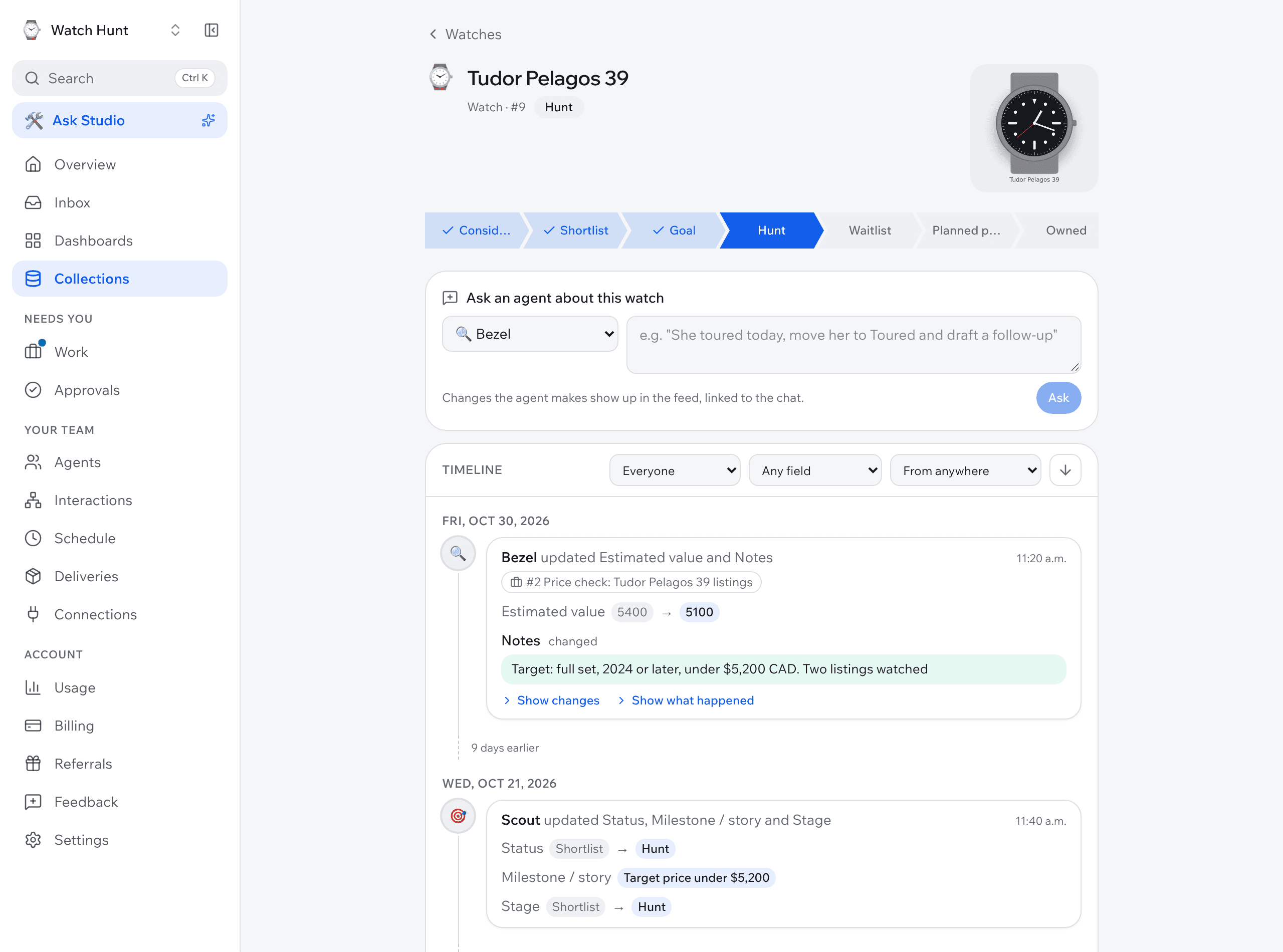
One piece, its stage, its history
The stage path runs Considered, Shortlist, Goal, Hunt, Waitlist, Planned purchase, Owned. Below it, every change with who made it and, when it ran from a work item, which one: the price researcher updated the value after a listing check, the hunt tracker moved it from Shortlist to Hunt. Ask an agent about the piece right from the page.
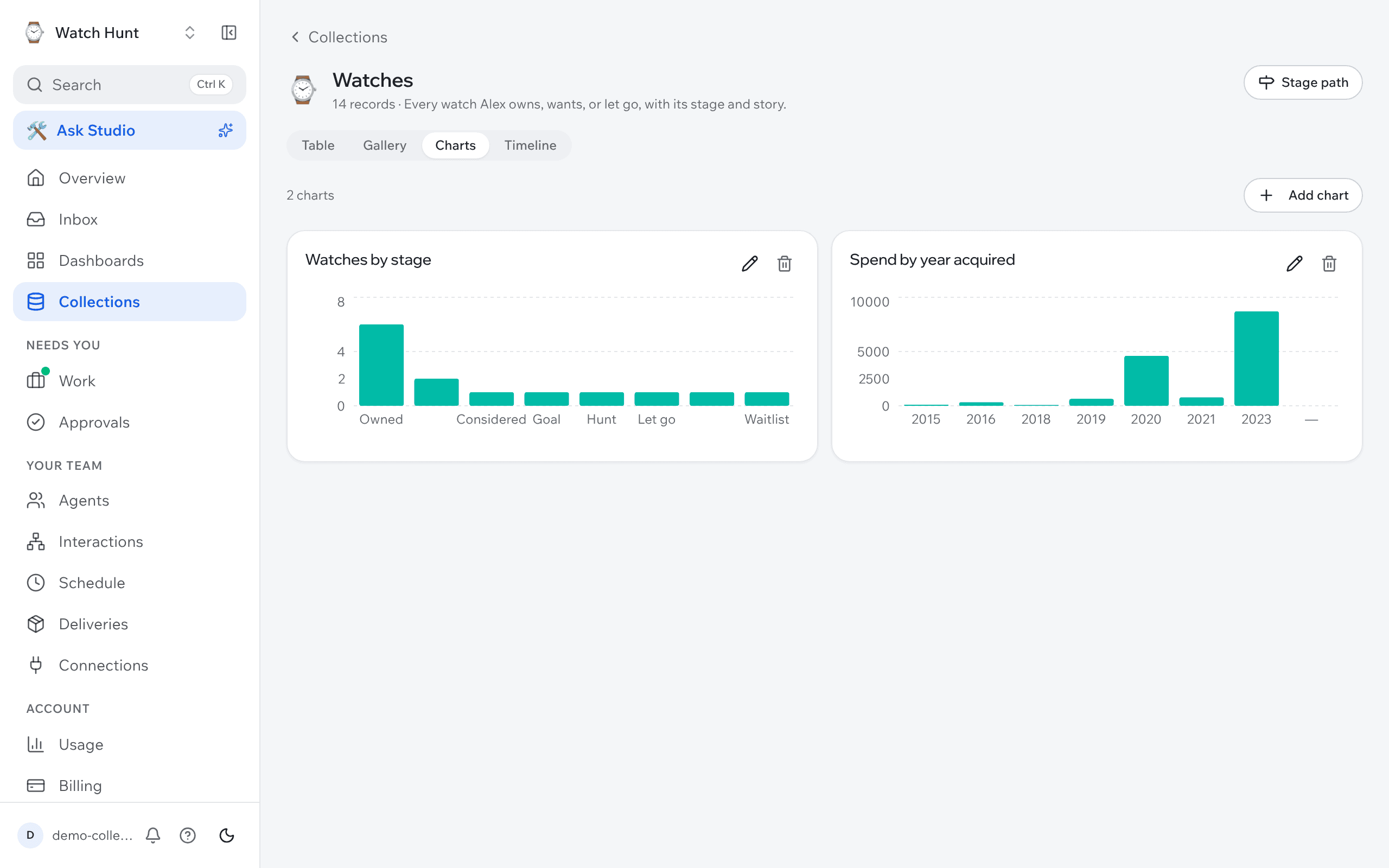
Charts over the whole registry
Saved charts computed live from every record: pieces by stage, spend by year acquired. Add your own, grouped by any pick-list or date field. Shared with the team, not a per-browser view.
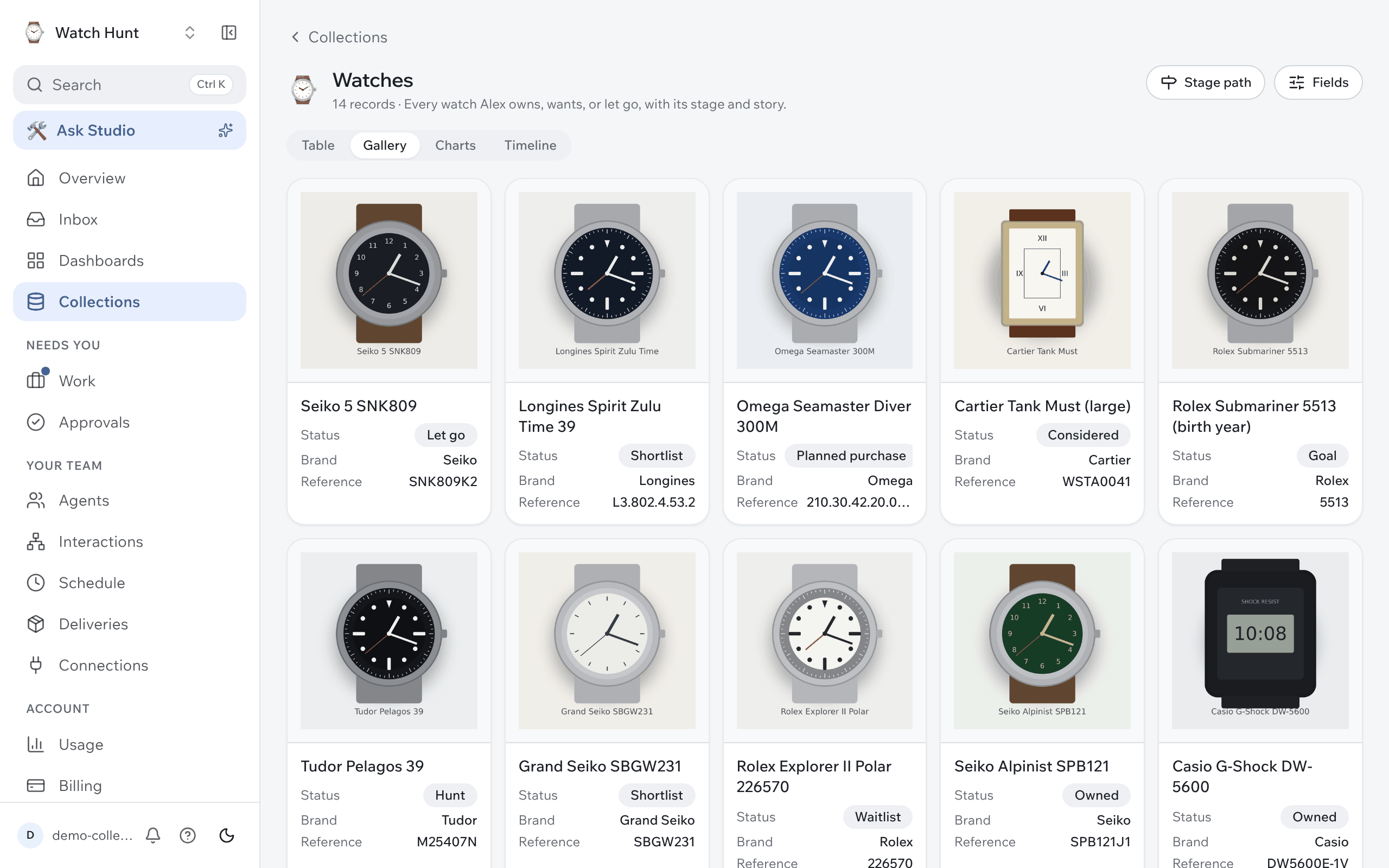
The gallery view
Picture first, the fields you choose underneath. The first image field on a collection becomes its thumbnail everywhere. Your keeper fills it from a photo you attach, or finds one online for the exact reference and notes the page it came from.
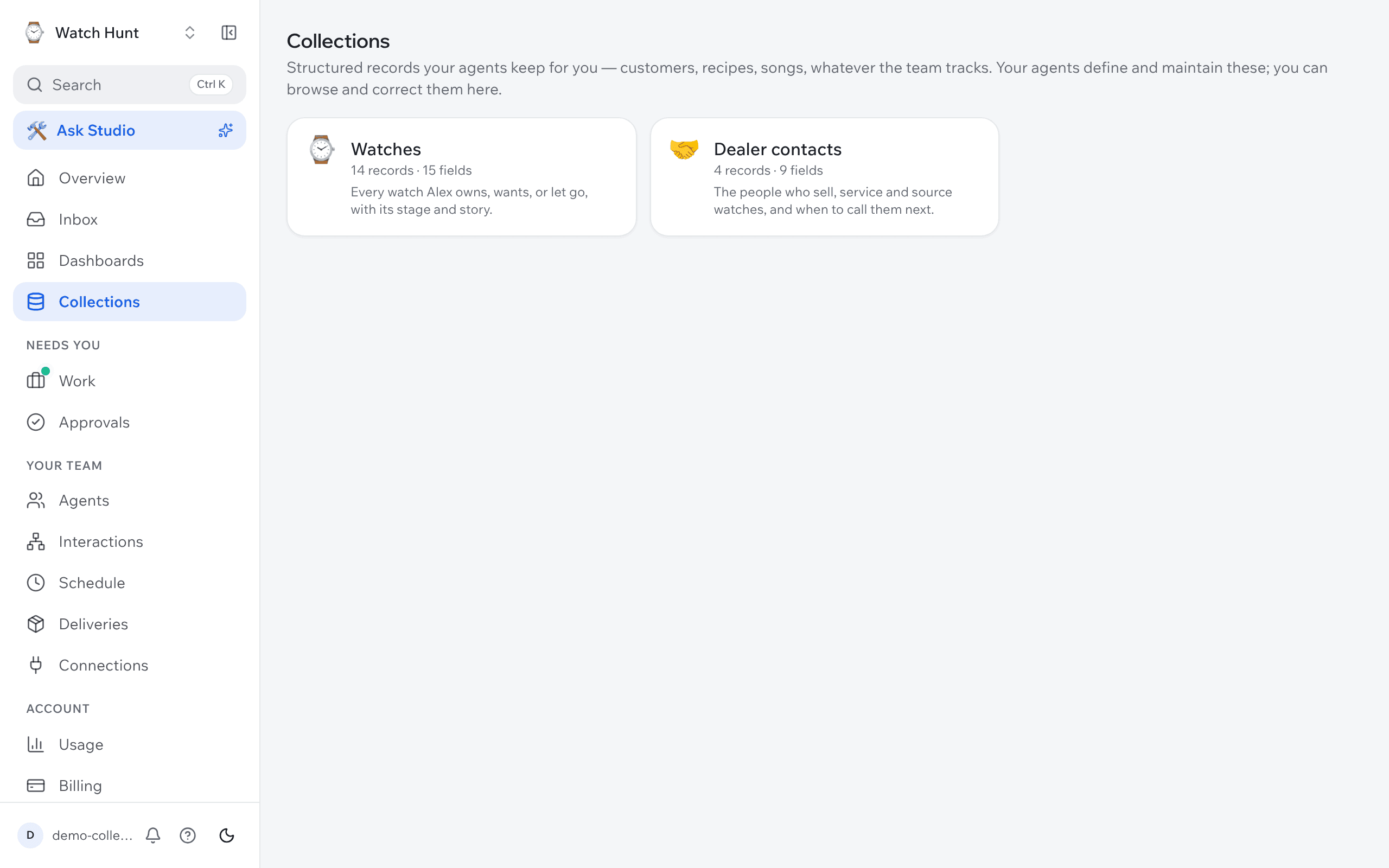
More than one collection per team
The watches and the dealer contacts live side by side, each with its own fields. Add straps, coins, cards or anything else as its own collection, or run a separate team per hobby.
Demo data, invented for these screenshots, and the watches are illustrations rather than photos. The interface, the stage path, the charts and the agent history are the real product.
Does this happen to you?
Three of the real cards. Your answers carry over when you sign up, so you never answer them twice.
“Someone asks how many pieces you own and you honestly don't know.”
Builds one registry: every piece, reference, specs, where it came from, what it cost, with a photo.
No access to your accounts until you connect them
You can rename your agents anytime.
Swipe the card, use the buttons, or the arrow keys.
Meet the full bench
Hire them all or just the ones you need, each is specialised, named, and editable once on board.
Collection Keeper
Builds and maintains the collection registry: one record per piece with specs, provenance, cost, value and photo. Turns it into tallies and an insurance schedule on request.
Hunt & Waitlist Tracker
Runs the hunt board inside the registry: goals, waitlists, shortlists, each with target price, timing, last update and next step. Flags what has gone quiet.
Market & Price Researcher
Searches live listings for the references you name, records asking prices with source and date, compares listings side by side, and lays out buy, hold or let-go numbers. Research only.
Dealer & Contact Book
Keeps a contact book of dealers, boutiques and fellow collectors: who, where, the relationship, every touch and its outcome, and the follow-ups that are due. Drafts check-ins; never sends them.
What gets done in week one
Real deliverables on a real work board, and anything that needs a tool you haven't connected is queued honestly, never faked as done.
One registry, with photos
Your keeper builds a collection: one record per piece with maker, reference, year, condition, where it came from, what it cost, the story, and a photo. Browse it as a table or a gallery, chart it by stage or by year, and open any piece to see its history. Every value comes from something you said, a receipt it read, or a listing it cites, never a guess.
Every hunt on one board
Considered, Shortlist, Goal, Hunt, Waitlist, Planned purchase, Owned, and Let go as the closed step: one stage path runs across the whole registry, so the pieces you own and the pieces you're chasing live in the same place. Your hunt tracker keeps target price, timing and next step on each, and flags a waitlist that's gone quiet.
Asking prices with receipts
Your researcher searches current listings for the reference you name and records every price with its seller, condition, link and date. No “typically goes for”. If a marketplace refuses to load, it says so. It has no way to buy, bid or message a seller: it holds no account of yours at all.
Dealers you walk in knowing
Your contact book remembers every boutique, dealer and fellow collector, what you talked about last, and what they promised. Once your calendar is connected, it proposes follow-up dates and asks before adding them, and it's told never to invite anyone. Check-in messages are drafted in your voice, and you send them.
Selling or making? It's your inventory
Run a boutique, a pre-owned shop or an online store, or flip a few pieces a year? The same registry tracks cost, asking price, what's listed, what's reserved and what sold, for how much and where. Ask for the numbers and your keeper works them out from your own rows: stock at cost, sales this month, margin per piece, how long each piece sat. On Pro, connect Shopify and give your keeper read access, and it reads your products and orders to flag anything that's out of step. Designing your own watches? The keeper tracks every reference from concept to delivered, with runs, units and price, in a collection of its own.
How it works
- 1
Swipe what happens in your week
A few quick cards. Each “that's me” adds the right specialist to your team.
- 2
Meet your team
They introduce themselves with a first job already assigned, and learn how you work from there.
- 3
Connect tools when ready
Gmail, Google Calendar, Drive, WhatsApp, Instagram, each granted per-agent, each unlocking more. Skip them and the team still works.
Then pay as you go, or a plan from $25/month · covers every team you're in · cancel anytime
Already use Claude, ChatGPT, or Gemini CLI?
Bring it. Your assistant knows you, so it can design this team around your actual week and hand you the roster to approve.
Questions collectors ask me
Does it work for things other than watches?
Yes. The registry is a collection whose fields your keeper designs for what you collect: grade and grading service for coins and cards, pressing and matrix number for vinyl, size for sneakers, edition for prints. Tell it what you collect in the first question and it builds the schema around it. The team was modelled on a real watch collector's team, and the same shape fits any hobby with references, hunts and dealers.
Can a dealer or a shop use it for inventory?
Yes. Pick "buying and selling" when it asks what you collect, sell or make, or just tell the keeper, and it adds seller fields to the registry: asking price, sold price, sold date and channel, with Listed, Reserved and Sold on the stage path. It works out stock at cost, sales and margin per piece, and how long pieces sit, from the numbers in your registry, and names any piece it left out for a missing cost. Selling on Shopify? On Pro, connect your store, give the keeper read access, and it reads your products and orders to catch a piece that's listed in one place and not the other, and asks before marking anything sold. For the rest of the shop (customers, bookkeeping, daily operations) there's a small business team, and one plan covers every team you're in.
Can a watch designer or a microbrand use it?
Yes. Pick "designing watches" when it asks what you collect, sell or make, or just tell the keeper. Your references get a collection of their own, one record each: the run or edition, units planned and sold, retail price, the unit cost you give it, your suppliers, and a stage path from Concept through Prototype, Pre-order and Production to Delivered. Hire the contact book too and your case, dial, strap and movement suppliers get the same follow-up tracking as dealers. The price researcher can pull what comparable watches list for, with sources, searching only with the details you're happy to share. It tracks and researches; manufacturing and orders stay with you.
Will it buy or bid for me?
No, and that is deliberate. The researcher finds listings and records prices with sources. The tracker drafts a check-in message. You click buy, you place the bid, you send the message. No agent on this team can spend money, send an email (sending is never granted) or message anyone on WhatsApp (there is none on the team). The one channel that could reach a dealer is a calendar invitation: the contact book starts unable to add calendar entries at all, asks before adding any once you allow it, and is told never to invite anyone.
Can it really check current prices?
It searches the web for live listings of the exact reference and reads the pages it can reach, then records the asking price, condition, seller, link and the date it looked. Some marketplaces block automated reads; when that happens it tells you rather than filling the gap with a guess. It never states a price it did not retrieve that day, and it never presents a sold price as an asking price.
How does it know what I own?
You tell it, piece by piece or in one long message, and it records exactly what you said. Attach a photo in chat and it goes on the record. Connect Gmail and your keeper can fill in purchase dates, sources and prices from real receipts in your inbox, naming the message each value came from. It cannot inspect, authenticate or appraise a piece, and it says so.
Can I keep several collections?
Yes. One team can hold several collections (watches and the straps for them, coins and banknotes side by side), each with its own fields, and you can run a separate team per hobby if you'd rather keep them apart. Every plan covers every team you're in.
Is my collection private?
Your registry lives in your team, visible only to the people you invite. Permissions are yours, and approval comes first. If you connect Gmail while hiring, the keeper gets read-only access to your mailbox: it can search and read, never draft, send or delete. The contact book starts with read-only access to a connected calendar and asks your permission before it can add anything; you choose whether it may. Once it can, asking before each entry and never inviting anyone are instructions it follows, not locks. Connect something after hiring and you pick the access level then. Price research sends only what you ask it to look up to a web search, and nothing else from your registry leaves the team.
What does it cost?
You pay for what the team actually uses, as you go or on a plan that covers every team you're in. The pricing page has today's numbers and any free credit for new sign-ups. Web search for price checks needs no extra subscription.